
This original instruction manual is crucial for Singer 15-91 sewing machines, especially the potted motor model. It guides users through proper machine operation, general maintenance, and basic attachment usage, ensuring comprehensive understanding and care for this vintage gem.
The Importance of the Original Instruction Book
Possessing the original instruction book for your Singer 15-91 sewing machine, particularly the potted motor model, is paramount for its proper care and operation. These vintage documents, often with a last copyright around 1941, serve as the definitive guide from the manufacturer. They ensure users receive accurate, model-specific information that generic guides cannot provide. Despite typical signs of age like scuffs or minor cover damage, as long as all 64 pages are present and readable, their value remains immense. The manual meticulously details the correct use and general maintenance practices essential for preserving your machine’s functionality and longevity. It also includes vital instructions on effectively utilizing the basic attachments, which are often unique to this specific model. Such a document prevents guesswork, clarifies operational nuances, and helps avoid potential damage from incorrect handling or maintenance. It’s not just a historical artifact; it’s a practical, indispensable tool for every Singer 15-91 owner, making the difference between a well-maintained, smoothly operating machine and one that struggles due to lack of proper guidance. Locating a good, usable condition manual, even if provided as a courtesy, is a critical step for any enthusiast.
Overview of the Singer 15-91 Model
The Singer Model 15-91 stands as a revered electric sewing machine, particularly distinguished by its “potted motor” design, a testament to its robust and reliable engineering. This iconic machine, often accompanied by an original instruction manual with copyrights as late as 1941, represents a significant era in home sewing technology. Owners of this vintage model benefit immensely from the comprehensive guidance offered in its instruction book, which elucidates its unique operational characteristics. The 15-91 is renowned for its direct drive motor, providing consistent power and smooth operation for a wide variety of sewing tasks. Its design prioritizes durability and precision, making it a cherished favorite among collectors and active users alike. The manual specifically addresses the machine’s general maintenance and intricate operational nuances, ensuring users can harness its full potential. It also provides detailed instructions for effectively using the basic attachments, integral to its versatility. Understanding the specific features and capabilities of the 15-91, including its robust construction and efficient electric drive, is made accessible through original documentation, highlighting its enduring appeal for practical sewing and restoration projects. This model’s legendary reliability has cemented its status as a classic workhorse.

Understanding the Manual’s Content
This 64-page Singer 15-91 manual, copyrighted 1941, covers machine use, general maintenance, and basic attachments. It’s a comprehensive guide, often showing typical signs of age, but ensures all essential information for operation is readily available.
Copyright and Publication Date
The instruction manual for this specific sewing machine model distinctly bears a ‘last copyright’ date of 1941. This precise date is exceptionally important, as it definitively establishes the document’s historical authenticity and its direct applicability to machines manufactured during that particular era. A 1941 copyright unequivocally verifies that the comprehensive instructions, intricate diagrams, and detailed operational guidance contained within this manual accurately reflect the technological standards, established manufacturing practices, and user expectations of the early 1940s. This venerable publication date profoundly underscores the remarkable longevity and the inherent robust design characteristic of these vintage machines, many of which continue to perform exceptionally well decades later. Typically comprising 64 pages, the manual’s substantial length was standard for comprehensive instructional booklets of its time, ensuring ample and exhaustive detail for all operational aspects. The availability of a manual from 1941 offers invaluable historical insight, serving as an authentic link to the original manufacturer’s intentions, recommended care procedures, and foundational user support. This crucial publication detail is indispensable for collectors, restorers, and current owners alike, enabling them to confidently operate their machine precisely according to its original, foundational specifications, historical context.
Scope of Use and General Maintenance
The comprehensive Singer 15-91 manual meticulously details the machine’s intended scope of use, empowering owners to fully leverage its capabilities across diverse sewing tasks. This invaluable document thoroughly elucidates the proper operation of the sewing machine, ensuring users can engage with its functions both effectively and safely, from simple mending to complex garment creation. Crucially, a substantial section of the manual is dedicated to general maintenance practices, which are absolutely paramount for preserving the machine’s inherent longevity and ensuring its consistent, optimal performance. It provides critical, step-by-step instructions on routine care, emphasizing methods to consistently keep the machine in pristine working order. This encompasses vital guidance on maintaining overall cleanliness, a key factor in preventing the accumulation of dust, lint, and fabric fibers that can severely impair internal mechanisms and stitching quality. Furthermore, the manual specifically outlines how to properly care for the machine’s delicate painted and robust plated surfaces, recommending precise cleaning techniques to prevent corrosion, maintain its vintage aesthetic, and avoid any superficial damage. Diligently adhering to these general maintenance guidelines, as originally prescribed by the manufacturer, is indispensable for ensuring the Singer 15-91 continues to function reliably and smoothly for countless years. Such diligent upkeep is fundamental in preventing premature wear and tear, thereby extending the operational lifespan and preserving the mechanical integrity of this durable and cherished sewing machine.
Instructions for Basic Attachments
The Singer 15-91 manual provides explicit and detailed instructions for effectively utilizing the machine’s basic attachments, which are essential tools for expanding its sewing capabilities. Understanding these instructions allows users to go beyond simple straight stitching, unlocking a broader range of creative and functional sewing applications. The manual covers the proper installation of each attachment, ensuring they are securely fitted to the machine for optimal performance and safety. Furthermore, it meticulously explains the specific adjustments required for each accessory, enabling precise control over various sewing techniques, such as hemming, gathering, or creating decorative finishes. Users will find clear guidance on the correct operational procedures for each attachment, detailing how to feed fabric, manage tension, and consistently achieve the desired stitch quality. This comprehensive coverage ensures that even novice users can confidently integrate these accessories into their sewing projects, enhancing both efficiency and the professional appearance of their work. By following these dedicated instructions, owners can fully leverage the versatility of their Singer 15-91, transforming it into a more adaptable and powerful sewing companion capable of tackling a wider array of textile challenges with ease and precision.

Manual’s Physical Description
The original instruction manual for the Singer 15-91 sewing machine, particularly the potted motor version, typically represents a durable document from its era. Bearing a last copyright date of 1941, these manuals are frequently encountered in “good, usable condition,” a testament to their robust construction and the care taken by previous owners. Physically, they often display “typical signs of age,” which commonly include scuffs, minor abrasions, or light discoloration on the covers, reflecting decades of handling and storage. Despite these superficial markings, a crucial aspect of their physical integrity is that “all pages are present,” ensuring that no vital information regarding the machine’s operation or maintenance is missing. Comprising “64 pages,” the manual is a substantial publication, indicating a comprehensive depth of content rather than a brief overview. This page count allows for detailed illustrations and extensive textual explanations, making it a thorough guide. The physical dimensions are generally practical, designed for easy reference alongside the sewing machine. Its enduring physical state, even with vintage wear, confirms its continued functionality as an essential companion for any Singer 15-91 owner, offering practical and accessible information for machine care and operation.

Core Machine Operations
Mastering your Singer 15-91 involves understanding fundamental tasks. This section details how to wind the bobbin correctly, thread the machine for optimal performance, and effectively operate the various controls and settings for diverse sewing projects.
How to Wind the Bobbin
Proper bobbin winding is a foundational skill for any Singer 15-91 operator, ensuring smooth stitching and preventing thread issues during your sewing projects. The process, detailed within the original instruction manual, is straightforward but requires attention to detail for best results. To begin, place your spool of thread on the spool pin, making sure it unwinds freely. Next, guide the thread through the tension disc specifically designed for bobbin winding, which helps ensure an even and consistent tension as the thread spools onto the bobbin. This step is crucial to avoid loose or tangled bobbins. After passing through the tension, securely place an empty bobbin onto the bobbin winder spindle. Engage the bobbin winder mechanism by pushing it towards the balance wheel until it locks into position. With the presser foot raised and needle disengaged (if applicable for your model, often by loosening the balance wheel clutch), gently press the foot controller. The machine will begin to wind thread onto the bobbin. Monitor the bobbin as it fills, ensuring the thread lays evenly. Once the bobbin is sufficiently full, or reaches the desired capacity, release the foot controller and disengage the winder. Cut the thread, and your perfectly wound bobbin is ready for insertion into the bobbin case, setting the stage for successful sewing on your Singer 15-91 machine.
Steps for Threading the Machine
Correctly threading your Singer 15-91 is a fundamental step to ensure proper stitch formation and prevent common sewing frustrations. The manual meticulously outlines this process, which, when followed precisely, guarantees smooth operation. Begin by placing your spool of thread on the spool pin, ensuring the thread unwinds from the front or top, depending on your spool’s orientation and the machine’s design for optimal tension. Next, guide the thread through the upper thread guide, typically a small loop or hook. From there, the thread must pass down through the tension discs. It is crucial here to ensure the thread is seated firmly between these discs, as this regulates the tension of the upper thread. Continue by bringing the thread up through the take-up lever, which moves up and down during stitching to provide and release thread. Thread the take-up lever from right to left, or as indicated in your specific manual. After the take-up lever, the thread descends again through a series of thread guides along the needle bar. Finally, thread the needle from the front towards the back. Once the needle is threaded, pull a few inches of thread through the eye. Remember to always bring the bobbin thread up through the needle plate before you begin sewing, creating a loop with the upper thread for a balanced stitch. These steps are vital for reliable performance.
Operating Controls and Settings
The Singer 15-91 manual provides comprehensive guidance on mastering its operating controls and settings, essential for diverse sewing projects. Understanding these mechanisms ensures precise stitch formation and smooth machine performance. Key among them is the stitch length regulator, typically a lever or dial, which allows users to select the desired stitch density, from short, tight stitches ideal for reinforcement, to longer basting stitches. The tension dial, crucial for balanced stitching, controls the upper thread’s pull; proper adjustment prevents looping or puckering. Users learn to raise and lower the presser foot using its designated lever, facilitating fabric placement and removal. The handwheel offers manual control, particularly useful for starting a seam slowly, pivoting corners, or bringing the needle to its highest position. Finally, the foot control governs the machine’s speed, enabling responsive and controlled sewing, from slow, deliberate stitches to faster, continuous seams, adapting to the user’s skill and project demands. Mastering these controls empowers the sewer to unlock the full potential of their robust Singer 15-91.

Essential Machine Care
Essential machine care for your Singer 15-91 is vital. This section details general maintenance, proper oiling for 15-90 and 15-91 models, and effective cleaning methods for paint and plated surfaces, ensuring longevity.
General Maintenance Practices
General maintenance practices are fundamental to preserving the operational integrity and longevity of your Singer 15-91 sewing machine. Adhering to a consistent schedule of basic care ensures this robust vintage model performs reliably for years. The original instruction manual emphasizes these routines, highlighting their importance in preventing wear and tear that can degrade machine function.
These practices typically involve more than just specific lubrication or surface cleaning; they encompass a holistic approach to the machine’s well-being. Regular inspection for unusual noises, vibrations, or loose components is a key aspect. Owners should routinely check the machine’s general condition, paying attention to areas where lint or thread fragments might accumulate, causing potential blockages or reduced efficiency. Dust and debris, if left unattended, can ingress into delicate mechanisms, hindering smooth operation, potentially leading to significant issues. Therefore, a gentle brushing or vacuuming of accessible areas after each use is highly recommended as a standard practice.
Understanding the machine’s overall health through these routine checks allows for early detection of minor problems before they escalate. This proactive approach, as outlined in the manual’s general maintenance sections, is crucial for extending the lifespan of your cherished Singer 15-91. Integrating these simple yet effective habits into your sewing routine safeguards your investment and ensures consistent, enjoyable experience. Following the manual’s guidance on general upkeep is paramount.
Oiling the Singer 15-91 and 15-90
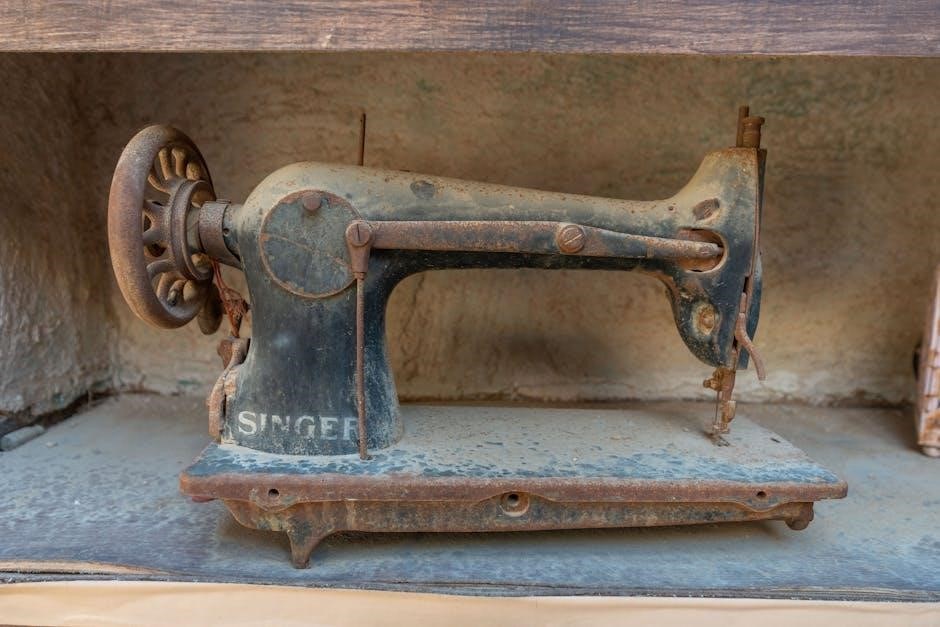
Proper oiling is a critical aspect of maintaining both the Singer 15-91 and 15-90 sewing machines, ensuring their smooth operation and extending their impressive lifespan. The instruction manual provides precise guidance on where and how frequently to apply lubricant, a step that cannot be overlooked for optimal performance. Neglecting this essential care can lead to increased friction, part wear, and ultimately, a less efficient and potentially damaged machine.
For these venerable models, understanding the specific oiling points is paramount. The manual details various apertures and moving parts that require a drop of high-quality sewing machine oil. This routine lubrication minimizes metal-on-metal contact, reducing heat buildup and preventing the sluggishness that can arise from dry mechanisms. Regularly oiling the Singer 15-91 and 15-90, as demonstrated in various online resources and instructional videos, ensures that all intricate components move freely and quietly, preserving the machine’s renowned reliability.
Many owners find that adhering to the manual’s oiling schedule, often after several hours of sewing or before prolonged storage, significantly contributes to the machine’s responsiveness. This simple yet vital practice is fundamental to keeping these classic Singer models in peak condition, allowing them to continue producing beautiful stitches for generations to come, truly embodying their robust engineering.
Cleaning Paint and Plated Surfaces
Maintaining the aesthetic integrity of your Singer 15-91 and 15-90 involves careful cleaning of its paint and plated surfaces. Over time, dust, grime, and environmental factors can dull the machine’s original luster. The instruction manual provides invaluable advice on suitable cleaning agents and techniques to avoid damaging these delicate finishes, ensuring preservation of its vintage appeal.
For painted areas, it is crucial to use gentle cleaners that will not strip the enamel or cause discoloration. Harsh chemicals or abrasive materials should be strictly avoided as they can irrevocably harm the finish. Similarly, plated components, such as chrome or nickel parts, require specific attention to prevent tarnishing and corrosion. A soft cloth, slightly dampened with a mild solution, is typically recommended for wiping down, followed by dry buffing.
Regular attention to these exterior parts not only enhances the machine’s appearance but also helps identify any potential issues early on. This meticulous approach, detailed in resources about caring for Singer 15-90 and 15-91 models, ensures your sewing machine remains a beautiful and functional piece of history for years to come, reflecting pride of ownership.

Utilizing Your Singer 15-91
This section guides you through effectively utilizing your Singer 15-91. It details understanding basic attachments for various sewing tasks and provides insights into operating your vintage machine, even when adapted with a modern motor for enhanced functionality.
Understanding Basic Attachments
Understanding basic attachments is fundamental for fully utilizing your Singer 15-91. The original instruction manual, particularly the 1941 copyrighted edition, offers comprehensive guidance for their proper use. These accessories are crucial tools, significantly enhancing the machine’s versatility, enabling precise execution of specialized sewing tasks. The manual meticulously details installation, adjustment, and operation of each attachment, from basic hemming to intricate gathering or binding. Mastering these components, like different presser feet or rufflers, transforms creative potential, leading to cleaner, professional results. Without the manual’s explicit instructions, users might miss the full capabilities of their vintage machine. It ensures complex projects are manageable, preserving functionality, and extending creative scope. Consulting these sections is essential for leveraging your Singer 15-91 across diverse applications, guaranteeing optimal performance and superior outcomes.
Using an Adapted Motor with the Machine
Utilizing an adapted motor with your Singer 15-91 can breathe new life into a classic machine, especially if the original ‘potted motor’ is no longer functional or for those seeking modern efficiency and increased power. While the vintage manual primarily covers the original setup, the fundamental principles of operating the sewing mechanism remain entirely consistent regardless of the motor source. Many enthusiasts adapt newer, high-quality direct drive motors to their Singer 15-91, offering reliable, often quieter, and more robust performance. When integrating such an adaptation, it’s absolutely crucial to understand the power requirements and ensure proper, secure installation to guarantee both safety and optimal function. Although the original instruction book won’t detail specific adapted motor installation procedures, it remains an invaluable resource for comprehending the core machine operations, such as precise bobbin winding and accurate threading, which are independent of the motor type. Proper machine maintenance, including regular oiling and thorough cleaning, also applies universally. Ensuring the adapted motor is securely mounted and correctly wired is paramount for safe and effective sewing, allowing this cherished Singer 15-91 to continue its legacy with enhanced power and control for countless projects.

Additional Resources and Manuals
For comprehensive support, beyond the user manual, the Singer 15-91 Adjusters Manual offers in-depth technical details. Additionally, numerous online resources and communities provide valuable information, troubleshooting tips, and ongoing assistance for your cherished machine.
The Singer 15-91 Adjusters Manual
Beyond the standard user instructions, the Singer 15-91 Adjusters Manual serves as an indispensable technical guide for owners and repair enthusiasts. This specialized document delves into the intricate mechanics of the machine, providing detailed schematics, precise adjustment procedures, and comprehensive troubleshooting steps that extend far beyond the scope of general maintenance covered in the basic instruction book. It is crucial for anyone looking to undertake more advanced repairs, fine-tune the machine’s performance, or identify specific components for replacement. Unlike the user manual, which focuses on daily operation and basic care, the Adjusters Manual offers in-depth insights into the machine’s internal workings, covering topics such as tension adjustments, timing synchronization, and lubrication points for internal mechanisms not typically accessed by the average user. It empowers individuals to diagnose complex issues and perform precise calibrations, ensuring the Singer 15-91 operates at its optimal level for generations. This resource is essential for maintaining the machine’s longevity and historical integrity, offering a deeper understanding of its engineering marvel. Acquiring this manual is a vital step for dedicated restorers and serious users who demand peak performance from their vintage sewing machine, providing the expert knowledge needed for intricate adjustments and repairs, safeguarding its enduring functionality.

Finding Online Support and Information
Finding online support and information for your Singer 15-91 machine is now highly accessible, critical for its long-term preservation. Digital versions of the original instruction book are widely available online, often provided as a courtesy, ensuring constant access to vital guidance even if your physical copy is damaged. YouTube is a rich resource with numerous creators offering visual tutorials. These videos demonstrate key operations, significantly enhancing understanding beyond text. Specialized content also covers essential machine care, including cleaning painted surfaces and proper oiling for 15-90 and 15-91 models. Beyond official documents and video guides, online forums, vintage sewing machine communities, and blogs serve as hubs for shared knowledge. They provide troubleshooting advice, discussions on adapting motors, and insights into attachments. These online avenues empower Singer 15-91 owners, keeping machines performing optimally and benefiting from a global network of enthusiasts and expert advice.
No Responses